


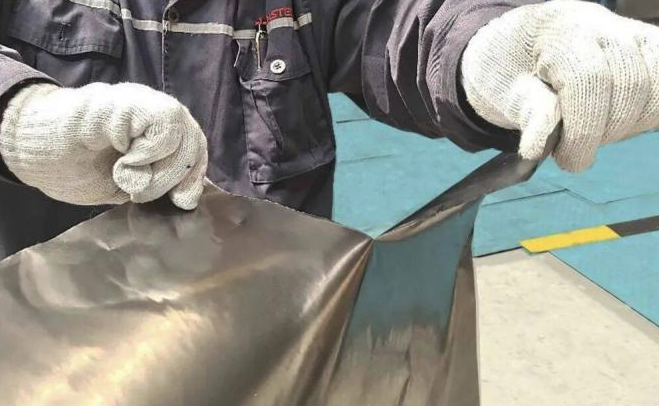
Recently, Ansteel successfully produced its first batch of ultra-thin non-oriented electrical steel (Prices) with a thickness of 0.1mm, marking another major breakthrough for Ansteel in the field of ultra-thin electrical steel. In this task, the Beijing Research Institute fully leveraged its research platform advantages and collaborated closely with the Silicon Steel Business Unit, providing comprehensive technical support in experimental verification, microstructure characterization, and performance evaluation, contributing significant scientific research strength to the successful launch of this product.
I. Precise Experimental Verification, Solidifying the Foundation of R&D
The development of 0.1mm ultra-thin electrical steel is not only a leap in size, but also a rigorous test of balancing the material's mechanical and magnetic properties. In the early stages of R&D, the Beijing Institute's research team conducted multiple rounds of simulation experiments in the laboratory for thin-gauge products. By precisely controlling experimental parameters, researchers systematically analyzed the impact of different normalizing temperatures, annealing temperatures, and other key processes on the material's grain size and uniformity, providing crucial data references for subsequent industrial production. In particular, regarding the issue of microstructure inheritance during the thinning process from 0.20mm/0.25mm to 0.1mm, the Beijing Institute utilized advanced simulation methods to assist the business unit in optimizing the process route.
II. In-depth microstructural characterization to reveal microscopic mechanisms
Organization determines performance. In the development of 0.1mm ultrathin silicon steel (Introduction), texture control is key to reducing iron loss. The Beijing Institute used high-resolution electron backscatter diffraction (EBSD) and X-ray diffraction (XRD) and other precision instruments to perform detailed microstructural characterization of the prototype samples. The characterization results not only reveal the evolution logic of materials under extreme thinning conditions, but also provide theoretical support for solving engineering problems such as strip breakage during ultra-thin plate rolling.
III. Collaboration between production and research opens a new chapter for high-performance silicon steel.
The successful development of this 0.1mm ultra-thin non-oriented electrical steel is another fruitful result of Ansteel's efficient collaborative model of "research and development in two locations and production in one place". As an "incubator" and "support tower" for cutting-edge technologies, the Beijing Institute has shortened the cycle of transforming scientific research results into productivity through seamless integration with front-line production units. In the future, Beijing Institute will continue to focus on the field of high-performance, thin-gauge electrical steel and deepen the application of new technologies such as AI4S (AI for Science) in materials research and development, helping Ansteel to continue to lead the new track of green energy materials.







|

|

|

|

|
| Timely Info | Independent | Platform | Multiple guarantees | Self-operated storage |
China Steel Market
Empowering small and medium-scale steel purchasing
| About us | Channel | Useful tools |
|---|---|---|
| About China Steel Market | Prices | Steel Weight Calculation |
| Contact Us | Answers | Why Choose Us |
| Terms & Conditions | Inventory | |
| Privacy Policy | Help |
Hot search words:
China Rebar prices China Wire Rod Prices Welded Steel Pipe Prices