30/12/2025
Tangsteel X60M Pipeline Steel Supports Major Water Supply Project Along The Belt and Road Initiative (BRI)
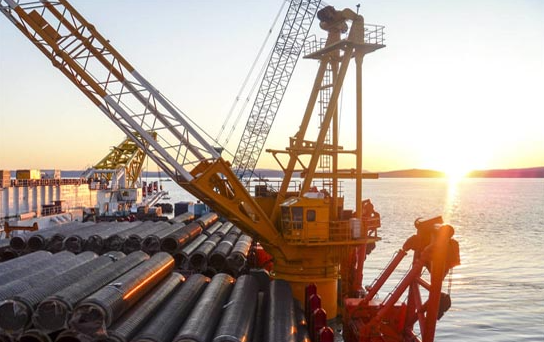
HBIS Tangsteel has successfully supplied high-end customized pipeline steel in bulk for major water conveyance projects in Belt and Road countries. Through outstanding product performance and comprehensive end-to-end services, the company has demonstrated its technological prowess and market competitiveness in the high-end steel sector.
Read More
23/10/2025
Jingye High-quality Steel Technology Successfully Trial-produced 0.20-0.25mm Ultra-thin Hard Rolled Coils
Recently, Jingye Group Technology Research Center, in collaboration with Gaopin Steel Technology Co., Ltd., successfully completed the trial production of 0.20-0.25mm ultra-thin hard rolled coils.
17/10/2025
Tiangang Company Successfully Trial Rolled Φ95mm Round Bar
Recently, the bar process of Tiangang Steel Rolling Plant has received another good news - the trial rolling of φ95mm round steel was successful!
14/08/2025
Tangsteel Develops Extremely Thick 420 MPa Grade Aluminized Coated Sheet
Recently, the first roll of 3.0mm ultra-thick 420MPa grade aluminum-coated sheet from Tangsteel Company of HBIS rolled off the production line successfully.
25/07/2025
Taihang Steel Successfully Rolled 22MnB5 Hot-Formed Steel
On July 16, Hebei Taihang Group successfully achieved the first rolling of 22MnB5 high-strength hot-formed steel after technical breakthroughs.
13/03/2025
Shagang Yongxing Successfully Developed a New Round Steel of Q355D
Recently, in the rolling mill workshop of Shagang Yongxing Company, the new specification of round steel Q355D was successfully developed, adding a new member to the round steel family.
28/02/2025
Shougang Jingtang Company's Hot Rolling 1580 Production Line Achieves 1.2 mm Ultra-thin Rolling
On February 20, 2025, Shougang Jingtang Company's hot-rolling 1580 production line successfully achieved the rolling of 1.2 mm ultra-thin products, marking another new breakthrough for Jingtang in the production of hot-rolled ultra-thin products.

Yes, but it depends on the specific application. For general mechanical structural purposes, it may suffice to simply meet the relevant delivery condition and dimensional requirements; however, if the part requires higher strength, hardness, or wear resistance, appropriate heat treatment and machining will typically also be necessary.
Process
Hot-dip galvanizing: The steel grating is immersed in molten zinc at about 450°C. The zinc reacts with the iron in a metallurgical process to form an alloy layer.
Cold galvanizing (electro-galvanizing): Zinc ions are deposited on the surface of steel grating through electrolysis, which is a physical adhesion process.
Corrosion resistance and lifespan
Hot-dip galvanizing: Extremely strong. Outdoor corrosion protection can last for 20 to 50 years, which is dozens of times longer than electroplated zinc.
Cold galvanizing: Relatively weak. In humid outdoor environments, its lifespan is typically only 2 to 5 years, and they are prone to rusting.
Zinc coating thickness
Hot-dip galvanizing: Very thick, usually between 50 and 150 μm, with a high zinc coating.
Cold galvanizing: very thin, usually only 5~30μm, using very little zinc.
Bonding strength and appearance
Hot-dip galvanizing: Zinc and iron are metallurgically bonded, resulting in extremely strong adhesion and making it difficult to peel off. The surface is silvery-white, possibly with zinc spangles, and is relatively rough.
Cold galvanizing: physical adhesion, weak bonding force, easily scratched and peeled off. The surface is smooth and uniform, resulting in a more delicate and glossy appearance.
In terms of process, hot-dip galvanizing involves immersing the entire steel grating in molten zinc at a temperature above 450°C. The zinc reacts with the iron in a metallurgical process, forming a zinc-iron alloy layer and a pure zinc layer on the surface. This bonding is at the chemical level; the zinc layer is integrated with the substrate, resulting in extremely strong adhesion.
Cold galvanizing (electro-galvanizing) takes a different approach: at room temperature, zinc ions are deposited on the surface of the steel grating through an electrolytic reaction. The zinc layer and the substrate are physically adsorbed together; there is no alloying process. This means that the zinc layer itself is very thin and has weak adhesion, making it easy to peel off under mechanical damage.
Differences in manufacturing processes directly determine the direction of all subsequent performance parameters.
The thickness of the zinc coating is the most reliable indicator and the most direct basis for judgment during on-site inspection.
According to GB/T 13912, the zinc layer thickness of hot-dip galvanized steel gratings, which are commonly used in 3- 5 mm flat steel, should have an average thickness of not less than 70μm, and a minimum thickness of not less than 55μm in some areas. The actual control in the industry is usually higher, with many manufacturers achieving an average of 85-100μm, and the requirements for outdoor heavy corrosion environments are even higher. The zinc layer thickness of cold galvanizing is generally only 5-15μm, which is only one-tenth or even less of that of hot galvanizing.
The amplification effect of this thickness difference on corrosion protection lifespan is very significant. Hot-dip galvanizing has a corrosion resistance life of 20-50 years in outdoor environments, while cold galvanizing usually rusts within 1-3 years in humid outdoor environments, and is also not considered durable under dry indoor conditions. Hot-dip galvanizing is like "wearing armor," while cold galvanizing is like "wearing cling film."
There are also identifiable differences in appearance. Hot-dip galvanized surfaces are silver-gray or dark gray, and may have a small number of zinc nodules or patterns, with a matte finish; cold-dip galvanized surfaces are exceptionally bright and smooth, almost like a mirror. If you see so-called hot-dip galvanized steel that is "so shiny it reflects light" at the procurement site, you should be more cautious.
Another easily overlooked but crucial engineering difference is the coverage of weld points and cuts. Hot-dip galvanizing involves immersing the entire finished product in zinc, with welds, cuts, and inner corners all covered by the zinc layer, leaving no dead corners. Cold galvanizing, on the other hand, often involves processing before electroplating, resulting in an incomplete zinc layer at the weld joints, making corrosion most likely to spread from the weld point.
The unit price of cold-dip galvanized steel grating is indeed lower. Cold-galvanized components often require replacement within about three years. Although the unit price of hot-dip galvanizing is high, it does not need to be changed for 20 years, and the average annual cost is only about one-third of that of cold galvanizing. This does not yet take into account the disruption to production and operation caused by repeated maintenance, as well as the safety risks caused by the reduced load-bearing capacity of the steel grating after corrosion.
For scenarios with high corrosion loads and difficult maintenance, such as sewage treatment plants, chemical platforms, coastal facilities, and power plant trestle bridges, hot-dip galvanizing is almost the only reasonable option. The price difference "saved" by using cold galvanizing in these areas is usually recovered many times over by maintenance costs and downtime losses within the first major overhaul cycle.
There are clear standards for the spacing of rebar in welded rebar mesh, mainly divided into two cases: the direction of fabrication and the vertical direction. The spacing of rebars in the direction of fabrication is usually limited to three standard values: 100mm, 150mm, and 200mm. This is the most common and standardized setting. Whether it's a pre-formed mesh or a custom mesh, this direction is basically based on these dimensions.
The spacing of the vertical reinforcing rebars is relatively flexible, ranging from 100mm to 400mm, and must be an integer multiple of 10mm. In other words, you can see specifications such as 100mm, 150mm, 200mm, 250mm, 300mm, 350mm, and 400mm, and in some cases, even more than 400mm.
If used for cement-concrete pavement of highways, when cold-rolled ribbed rebars are used, the longitudinal steel bar spacing should not exceed 200 mm, and the transverse rebar spacing should not exceed 300mm.
The allowable deviation of grid spacing is usually ±10mm. The control standards for this deviation are slightly different at the factory and during site acceptance, but they are both within this range.
In areas of stress concentration, such as at floor corners or where pipes pass through, the spacing may be increased to 80mm or even 50mm, but this is a special design and not a standard specification.
China Steel Market
Empowering small and medium-scale steel purchasing
Hot search words:
China Rebar prices China Wire Rod Prices Welded Steel Pipe Prices