

 16/03/2026 10:18:53
 2 answers in:
Application
2 answers in:
Application


Cross-sectional Shape
I-beams (I-sections): Their cross-sectional shape resembles a capital "I," with a narrow, high web and relatively wide flanges. The inner surface of the flanges is typically inclined, making the flanges thinner at the ends and thicker at the root.
H-beams: The cross-sectional shape of H-beams is closer to the letter "H." Compared to I-beams, H-beams have wider flanges, and the inner surfaces of the flanges are parallel, meaning the thickness of the flanges is uniform throughout.
Manufacturing Process
I-beams: Typically manufactured through hot rolling or cold bending. Due to their specific cross-sectional shape, the manufacturing process of I-beams is relatively more complex.
H-beams: Can be produced by hot rolling or welding. Modern mass-produced H-beams mostly use hot rolling, which results in more uniform product quality and a higher strength-to-weight ratio.
Mechanical Properties
I-beams: Due to the inclined design of the inner surface of the flanges, the stress distribution of I-beams under lateral forces is less uniform than that of H-beams, and their torsional resistance is relatively weaker.
H-beams possess superior mechanical properties, particularly excelling in bearing vertical loads. Their symmetrical design ensures a more uniform stress distribution under load, while also providing excellent resistance to bending, shearing, and torsion.
Time:24/03/2026 15:28:37
H-beams and I-beams are different in shape.
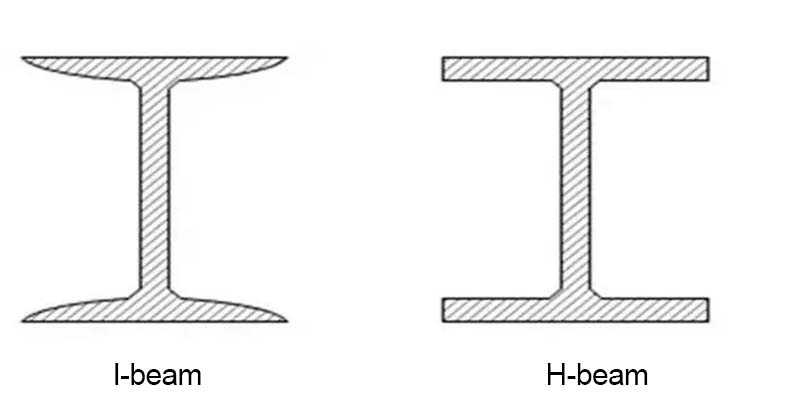
I-beams are mainly divided into ordinary I-beams, lightweight I-beams, and wide-flange I-beams. Based on the flange-to-web height ratio, they are further divided into wide, medium, and narrow wide-flange I-beams. The first two types are produced in sizes 10-60, corresponding to heights of 10-60cm.
H-beams are a widely used profile in modern steel structure construction. The main difference between them and I-beams lies in the flange design—H-beams have no inclination, and the upper and lower surfaces are parallel, providing more uniform cross-sectional properties. Due to their optimized cross-sectional area distribution and strength-to-weight ratio, H-beams have become an economical and efficient profile choice.
I-beams: Due to their relatively high and narrow cross-sectional dimensions, I-beams have a significant difference in moments of inertia about their two principal axes, making them suitable for members subjected to bending within the plane of their web or for forming lattice-type load-bearing members. However, I-beams are not suitable for applications requiring axial compression or bending perpendicular to the web plane.
H-beams: H-beams offer higher load-bearing capacity and better structural stability, making them suitable for high-rise buildings, heavy-duty factories, large bridges, and other projects with high requirements for structural strength and stability. Their optimized cross-sectional design allows for efficient use of steel, increasing load-bearing capacity and facilitating connection with other components using high-strength bolts.
I-beams: Flexible design, easy to cut and weld; resistant to aging, long service life; lightweight, convenient construction, helping to shorten construction time; aesthetically pleasing, meeting general aesthetic standards; possesses good insulation, magnetic permeability, and fire-retardant properties.
H-beams: High structural strength, saving metal materials; diverse design styles, more flexible building layout; lightweight, reducing foundation requirements and lowering costs; good structural stability, particularly suitable for buildings in earthquake-prone areas; increases usable area, improving economic efficiency; easy to process, connect, and install, supporting industrialized manufacturing.
Time:16/03/2026 17:20:17


|

|

|

|

|
| Timely Info | Independent | Platform | Multiple guarantees | Self-operated storage |
China Steel Market
Empowering small and medium-scale steel purchasing
| About us | Channel | Useful tools |
|---|---|---|
| About China Steel Market | Prices | Steel Weight Calculation |
| Contact Us | Answers | Why Choose Us |
| Terms & Conditions | Inventory | Avoiding Trade Fraud Guide |
| Privacy Policy | Help |
Hot search words:
China Rebar prices China Wire Rod Prices Welded Steel Pipe Prices